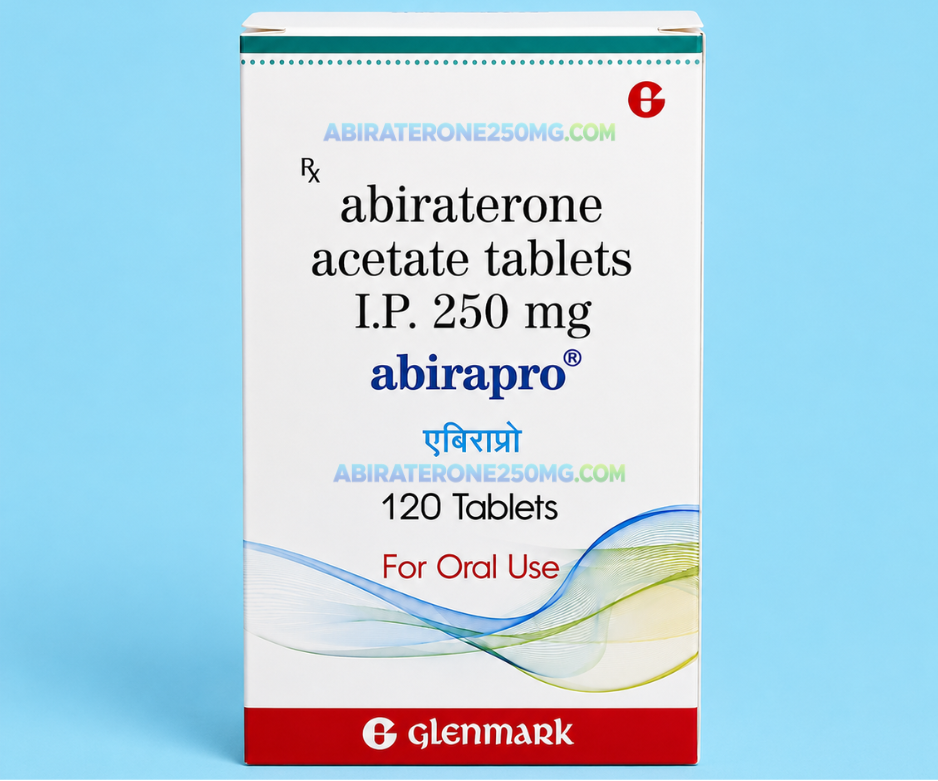
Abiraterone 250 mg
Disclaimer: Before purchasing any medicine, always verify whether there is a valid drug license.
Abiraterone 250 mg refers to an oral tablet containing 250 mg of abiraterone acetate, an androgen-biosynthesis inhibitor used with corticosteroid therapy for specified forms of advanced prostate cancer. Abiraterone acetate is converted in the body to abiraterone, which inhibits CYP17A1, an enzyme involved in androgen production.
The established reference product is ZYTIGA (abiraterone acetate). The drug’s early discovery and development originated from research at the Institute of Cancer Research (ICR) in London, with work supported through Cancer Research UK-related programs. Abiraterone was subsequently licensed to Cougar Biotechnology, which developed it clinically and was later acquired by Johnson & Johnson.
The specific manufacturer, authorization holder and regulatory status of any particular generic Abiraterone 250 mg product should be confirmed from its packaging and applicable regulatory documentation.
| Topic | Information |
|---|---|
| Product | Abiraterone 250 mg |
| Active ingredient | Abiraterone acetate |
| Strength | 250 mg |
| Dosage form | Oral tablet |
| Drug class | CYP17 inhibitor / androgen-biosynthesis inhibitor |
| Therapeutic area | Prostate cancer |
| Reference product | ZYTIGA |
| Original research/development | Institute of Cancer Research / Cancer Research UK-supported program |
| Clinical development | Cougar Biotechnology / Johnson & Johnson |
| Initial U.S. approval | 2011 |
| Specific generic manufacturer | Hikma Pharmaceuticals |
| Product-specific regulatory status | Globally approved |
What is abiraterone acetate?
Abiraterone acetate is the acetate prodrug of abiraterone. After administration, it is converted to abiraterone, which inhibits CYP17A1, an enzyme involved in the production of androgens.
Androgens can stimulate the growth of prostate cancer cells. By reducing androgen synthesis, abiraterone can reduce androgen signaling and slow the progression of androgen-dependent prostate cancer.
Because CYP17 inhibition can also reduce cortisol production and increase mineralocorticoid-related effects, abiraterone is administered with corticosteroid therapy according to the applicable prescribing information.
What is Abiraterone 250 mg used for?
Current U.S. ZYTIGA labeling identifies abiraterone acetate as a CYP17 inhibitor used in combination with prednisone for:
-
Metastatic castration-resistant prostate cancer (mCRPC)
-
Metastatic high-risk castration-sensitive prostate cancer (CSPC)
The approved population and corticosteroid regimen can differ according to the indication and jurisdiction.
Abiraterone should therefore be used only for an indication supported by the applicable local prescribing information and under supervision of an appropriate healthcare professional.
How does abiraterone work?
Abiraterone works by inhibiting CYP17A1, which has both 17α-hydroxylase and C17,20-lyase activity.
These enzymatic activities are important in androgen and steroid hormone biosynthesis. Inhibiting CYP17 reduces androgen production from several sources, including the testes, adrenal glands and prostate tumor tissue.
This mechanism distinguishes abiraterone from conventional cytotoxic chemotherapy. It is generally classified as a hormonal or androgen-synthesis-targeted anticancer therapy.
Abiraterone 250 mg and the usual daily dose
The 250 mg tablet strength can be used to construct the labeled daily dose. For the current U.S. ZYTIGA regimen, the standard adult dose is 1,000 mg once daily, equivalent to four 250 mg tablets when that tablet strength is used.
The prescribed dose should not be interpreted independently of the patient’s diagnosis, treatment combination, liver function and other clinical factors.
Patients should not change the number of tablets taken without specific instructions from their healthcare professional.
Reference Product: ZYTIGA
The established reference product for abiraterone acetate is ZYTIGA.
The U.S. Food and Drug Administration granted the original U.S. approval for ZYTIGA in April 2011. The initial approval was for use with prednisone in men with metastatic castration-resistant prostate cancer who had previously received docetaxel-containing chemotherapy.
Johnson & Johnson’s historical documentation states that ZYTIGA was developed by Ortho Biotech Oncology Research & Development, a unit of Cougar Biotechnology, and marketed in the United States by Centocor Ortho Biotech following Johnson & Johnson’s acquisition of Cougar Biotechnology.
Current U.S. labeling identifies Janssen Biotech, Inc. as the company for which ZYTIGA is manufactured.
Origin and First Development of Abiraterone
The history of abiraterone began before the commercial ZYTIGA product.
Research at the Institute of Cancer Research (ICR) in the United Kingdom investigated ways to inhibit androgen synthesis. Abiraterone was first synthesized at the ICR as part of a program supported by the British Technology Group (BTG). It was subsequently licensed to Cougar Biotechnology, which undertook further pharmaceutical and clinical development.
Cancer Research UK describes the subsequent development pathway as involving formulation into an oral medicine, early clinical studies at the ICR and Royal Marsden, and later development with pharmaceutical-industry support.
Originator and manufacturer distinction
It is important to distinguish several roles:
-
Original scientific development: Institute of Cancer Research and associated Cancer Research UK-supported research.
-
Clinical/commercial development: Cougar Biotechnology, subsequently part of Johnson & Johnson.
-
Reference product: ZYTIGA.
-
Historical U.S. marketing organization: Centocor Ortho Biotech.
-
Current U.S. product company identified in labeling: Janssen Biotech, Inc.
-
Specific generic manufacturer: Must be verified for each individual product.
Therefore, it would be inaccurate to state that every generic abiraterone 250 mg tablet is manufactured by Janssen or Johnson & Johnson.
Abiraterone 250 mg versus ZYTIGA
A generic abiraterone acetate product contains the same active pharmaceutical ingredient as the reference medicine when appropriately authorized, but it should not automatically be described as the same commercial product as ZYTIGA.
Differences may include:
-
Manufacturer
-
Brand name
-
Excipients
-
Tablet appearance
-
Packaging
-
Manufacturing site
-
Marketing authorization holder
-
Regulatory jurisdiction
-
Commercial supply chain
The product-specific information for a generic Abiraterone 250 mg should therefore be checked against its own official documentation.
Important Safety Information
Abiraterone can cause clinically significant adverse effects related to CYP17 inhibition and other pharmacologic effects.
Important risks include:
-
Hypertension
-
Hypokalemia
-
Fluid retention or edema
-
Hepatotoxicity
-
Adrenal insufficiency
-
Cardiovascular complications
-
Abnormal liver-function tests
Mineralocorticoid-related effects can occur because CYP17 inhibition alters steroid hormone production. Corticosteroid therapy is therefore an important component of the labeled treatment regimen.
Patients receiving abiraterone may require monitoring of blood pressure, serum potassium, fluid-retention symptoms and liver function.
Liver Function and Hepatotoxicity
Abiraterone can cause liver injury, including clinically significant elevations in liver enzymes.
Patients with pre-existing hepatic impairment may require particular consideration, and liver-function testing should be performed according to the applicable prescribing information.
If significant liver toxicity develops, treatment interruption, dose modification or discontinuation may be necessary.
Blood Pressure, Potassium and Fluid Retention
Because abiraterone interferes with steroid biosynthesis, treatment can produce mineralocorticoid excess.
This may manifest as:
-
Increased blood pressure
-
Low potassium levels
-
Fluid retention
-
Peripheral edema
These effects are clinically important because severe electrolyte or cardiovascular complications can occur in susceptible patients.
Corticosteroid Combination
Abiraterone acetate is not ordinarily used as a standalone treatment under the labeled ZYTIGA regimens.
Current U.S. labeling specifies use with prednisone, with the prednisone regimen depending on whether the treatment is being used for metastatic castration-resistant or metastatic castration-sensitive prostate cancer.
The patient should follow the exact corticosteroid regimen prescribed by the treating clinician.
Administration
Abiraterone acetate tablets should be taken exactly according to the applicable prescription information.
For current U.S. ZYTIGA labeling, abiraterone acetate is administered once daily. The medicine should be taken according to the official instructions concerning food because food can substantially affect abiraterone exposure.
Patients should not independently substitute administration instructions from one abiraterone product for another without checking the applicable product information.
Clinical Development
The clinical development of abiraterone represented an important advance in treatment of advanced prostate cancer because it demonstrated that androgen production could be therapeutically suppressed beyond conventional androgen-deprivation approaches.
The pivotal development program included the COU-AA-301 study in men with metastatic castration-resistant prostate cancer previously treated with docetaxel. The study demonstrated improved overall survival with abiraterone acetate plus prednisone compared with prednisone plus placebo.
The FDA subsequently granted the original U.S. approval on April 28, 2011.
Verification Process
Scan the QR code printed on the product box. The QR code will take you to the official product verification page, where you can complete the verification process.
The QR code will direct you to the e-verification page, where you can complete the product verification process.
After completing the verification, check the result carefully to confirm whether the product is genuine.
If the verification indicates that the product is fake or unauthorized, do not use it. Report the suspected counterfeit product and take appropriate legal action against the supplier through the Directorate of Drug Administration (DGDA), World.
Always purchase medicines from licensed pharmacies or authorized suppliers and verify the product before use.
Medical Information Disclaimer
This website provides general educational information about abiraterone acetate and does not provide individualized treatment recommendations.
Abiraterone is a prescription anticancer medicine. The appropriate indication, dose, corticosteroid regimen, monitoring plan and treatment duration must be determined by a qualified healthcare professional using the prescribing information applicable to the patient’s country.
Do not start, stop, increase or decrease abiraterone or prednisone based solely on information published on a website.
Key Takeaways
-
Abiraterone 250 mg contains 250 mg of abiraterone acetate.
-
Abiraterone acetate is an oral CYP17 inhibitor.
-
The established reference product is ZYTIGA.
-
The original scientific work leading to abiraterone was conducted at the Institute of Cancer Research, with Cancer Research UK/related support.
-
Cougar Biotechnology subsequently undertook major clinical and commercial development before its acquisition by Johnson & Johnson.
-
ZYTIGA received its initial U.S. approval in 2011.
-
Current U.S. labeling identifies Janssen Biotech, Inc. in connection with ZYTIGA.
-
Generic Abiraterone 250 mg products should not automatically be identified as ZYTIGA or as being manufactured by Janssen.
-
Product-specific manufacturer and regulatory information should be verified from the actual generic product documentation.
-
Abiraterone treatment requires appropriate medical supervision because of risks including hypertension, hypokalemia, fluid retention and liver toxicity.
References
-
U.S. FDA/DailyMed — ZYTIGA (abiraterone acetate) prescribing information.
-
Johnson & Johnson — ZYTIGA FDA approval and development history.
-
Institute of Cancer Research / PubMed — development history of abiraterone acetate.
-
Cancer Research UK — history of abiraterone development.
-
FDA approval summary published in Clinical Cancer Research.
Michael R.
Very useful information about Abiraterone 250 mg. The explanation of how abiraterone works, how it is taken, and the importance of monitoring made the information easy to understand.
David K.
I found the FAQ section especially helpful. It clearly explains common questions about abiraterone acetate, food restrictions, side effects, and the role of prednisone.
James T.
The information is well organized and easy to follow. I appreciated the clear explanation of Abiraterone 250 mg, its treatment use, safety considerations, and important precautions.
Latest News
Hello world!
August 18, 2026 | by Abiraterone250mg
Welcome to WordPress. This is your first post. Edit or delete it, then start writing!
Read More →
FAQs
The active ingredient is abiraterone acetate. Each tablet contains 250 mg of abiraterone acetate.
Yes. Abiraterone acetate is a prescription anticancer medicine and should be used under the supervision of a qualified healthcare professional.
Abiraterone is an androgen-directed medicine that inhibits CYP17, an enzyme involved in the production of androgen hormones.
Abiraterone is generally used as part of a combination treatment plan. Current U.S. labeling specifies its use with prednisone and continued androgen-deprivation therapy where applicable.
Follow the missed-dose instructions provided with your specific product and prescription. Do not take an extra dose unless your healthcare professional specifically advises you to do so.
Abiraterone is taken once daily. The important administration requirement is to follow the prescribed schedule and take the tablets on an empty stomach as directed in the applicable product information.
Food can substantially affect the amount of abiraterone absorbed into the body. Taking the medicine on an empty stomach helps maintain the administration conditions specified in the prescribing information.
Monitoring may include blood pressure, potassium levels, liver function and signs of fluid retention. Your healthcare professional will determine the appropriate monitoring schedule.
Yes. Abiraterone treatment can be associated with changes in laboratory measurements, including liver enzymes and potassium levels. Regular testing may therefore be recommended during treatment.
Tell your doctor about your medical history, especially liver problems, heart or cardiovascular conditions, blood-pressure problems, and all prescription medicines, over-the-counter medicines and supplements you use.